Oven Repair
Viking Oven Slow to Preheat: Reading the Igniter
A Viking oven that crawls up to 350°F, or stalls short of it, is usually a weakening bake igniter rather than a failed control board. How to tell the difference from the kitchen, and what the amp reading decides.
- Published
- Read time
- 4 min
- Appliance
- Oven Repair
- Checked by
- Hollis Yamada
- Bench role
- Service technician — refrigeration and cooking
- At the bench
- 21 years in the trade
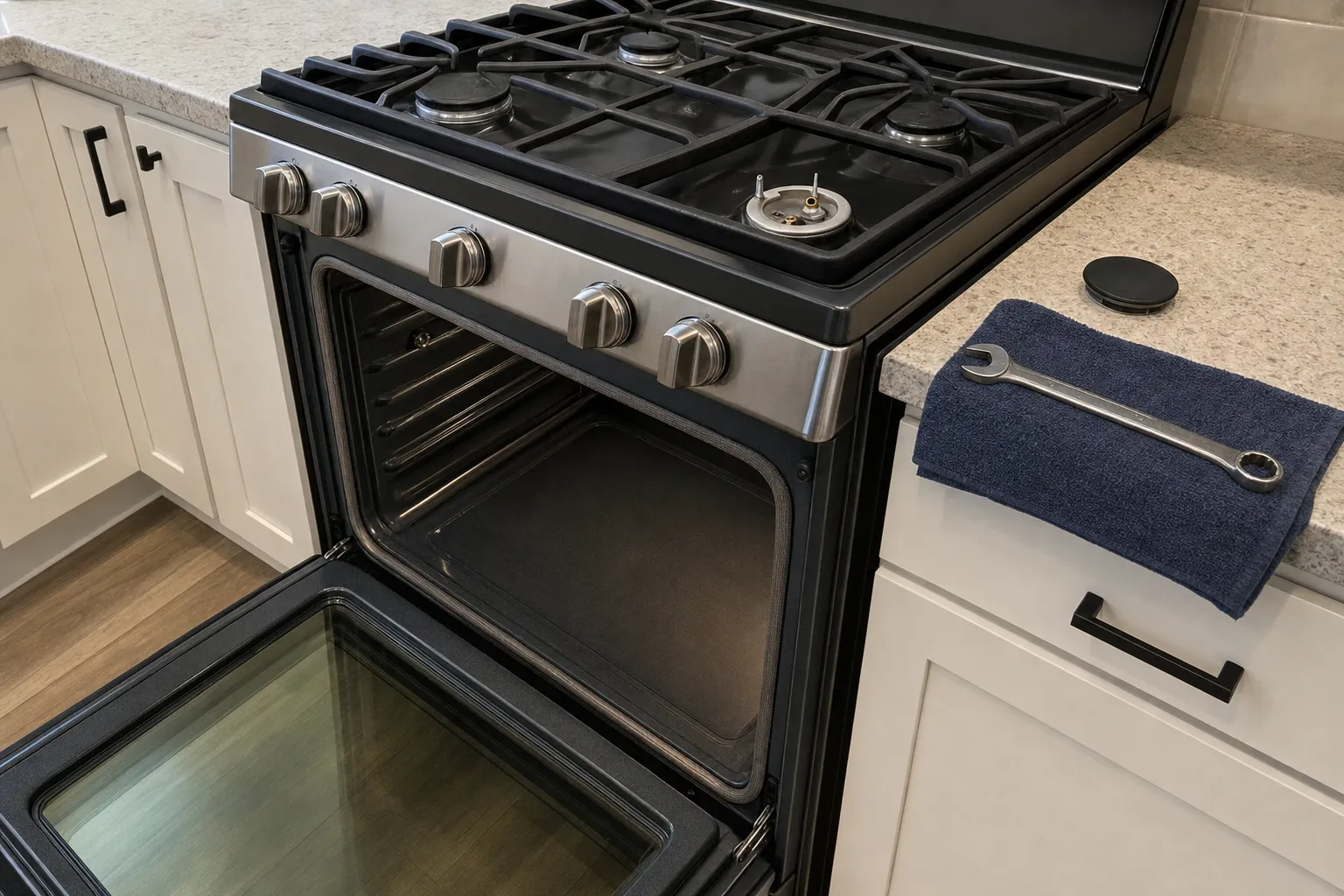
An oven that used to reach 350°F in twelve minutes and now takes forty is a different complaint from an oven that will not heat at all, and it gets a different diagnosis. The slow version is a gradual electrical degradation with a specific, measurable signature — and on Viking gas ovens that light with a glow-bar igniter it is usually the same component.
The trouble is that the component in question looks perfectly healthy while it fails. That is why these ovens frequently arrive at us having already had a control board fitted by somebody else.
How the ignition circuit actually works
On a gas oven the igniter does two jobs at once, and the second one is the one people do not expect.
Job one is obvious: it glows hot enough to light gas. Job two is that it acts as the current-sensing element in series with the safety valve. The valve is only pulled open when enough current flows through the circuit — typically around 3.2 to 3.6 amps on a Viking bake circuit. That threshold exists deliberately, so gas cannot be admitted unless the igniter is definitely hot enough to light it.
As an igniter ages, its resistance rises. It still glows. It glows brightly, in fact — bright enough that every homeowner who looks into the cavity concludes it is working. But current has dropped below the threshold, the valve stays shut longer than it should, and the burner lights late or intermittently.
That is the slow preheat. Not a broken part; a part that has drifted out of specification.
Reading the symptom from the kitchen
You can get a long way before anyone puts a meter on it.
Slow only at high setpoints is early-stage. The oven manages 200°F for proving dough but takes an age to reach 425°F. Low setpoints need fewer valve openings, so a marginal igniter still copes.
Uneven baking, pale tops, burnt bottoms points the same way. The burner is lighting late in each cycle, so the cavity spends more time recovering than holding, and the radiant heat from below dominates.
A long glow before the burner catches is the clearest tell of all. On a healthy circuit the burner catches soon after the igniter reaches full glow. If you are watching it glow for minutes before ignition, the current is marginal.
No F-code on the display is itself diagnostic. A weak igniter does not generate an error, because nothing in the circuit is out of range from the control board’s point of view — the board asked for heat, and eventually it got heat. Boards throw codes for sensor faults, not for slow ignition. An oven that is slow and silent is pointing at the igniter; an oven that is slow and throwing an F-code is pointing somewhere else.
What else it could be
Three other causes produce something that resembles slow preheat, and they are worth ruling out because two of them are cheap.
A drifting oven temperature sensor reads the cavity hotter than it is, so the control cuts the burner early and the oven sits below setpoint indefinitely. The oven feels slow but is actually holding — at the wrong number. On ovens with an electronic control, a meter on the sensor at room temperature settles it; Viking’s VGSO166 chart gives about 1,100 ohms at 75°F.
A failing door gasket lets the cavity bleed heat as fast as the burner supplies it. This one is easy to check with the oven cold: close the door on a strip of paper at several points, and where it slides out freely, the seal is leaking. Common on Viking ranges in older Education Hill kitchens where the door has been slammed for fifteen years.
A restricted gas supply — a partly closed shutoff behind the range after somebody pulled it out to clean — starves the burner. Rare, but it costs nothing to check and it has embarrassed better technicians than us.
What the amp reading decides
The whole diagnosis comes down to one number. We put a clamp meter on the igniter leg and watch the current as the circuit heats.
Within Viking’s 3.2 to 3.6 amp range, the igniter is doing its job and the fault is elsewhere — sensor, gasket, gas supply, or the control. Below 3.2 amps, the igniter is the fault: it draws enough to glow and not enough to open the valve fully.
That single reading is what separates a modest part replacement from an expensive guess. It is also why a slow oven should never end with a new control board on the first visit. If somebody proposes a board without showing you an amp draw, ask what the reading was.
An igniter is a consumable, and it fails gradually enough that most people adapt to it long before they call. If your oven has been “a bit slow lately” for a year, this is almost certainly what has been happening.
Common follow-ups
Can I keep using an oven that preheats slowly?
For a short while, yes — a weak igniter is not an emergency while the oven still lights and holds, but a gas smell means switch the oven off and call from outside. What you should not do is leave it for months. At the end of that road the igniter glows but never pulls the valve open, so the oven simply stops lighting. Book it before it gets there.
Does a glowing igniter mean the igniter is fine?
No, and this is the single most common misreading of this fault. The igniter is both the heat source and the current-sensing element that opens the gas valve. It can glow bright orange and still draw too little current to pull the valve open. Glow tells you nothing; the amp draw tells you everything.
Why is the oven fine at 200°F but slow at 425°F?
Because a weak igniter still manages the short, infrequent cycles a low setpoint needs. The higher the setpoint, the more often the valve has to be pulled open, and the more often a marginal igniter misses. Slow only at high temperatures is a classic early-stage symptom.